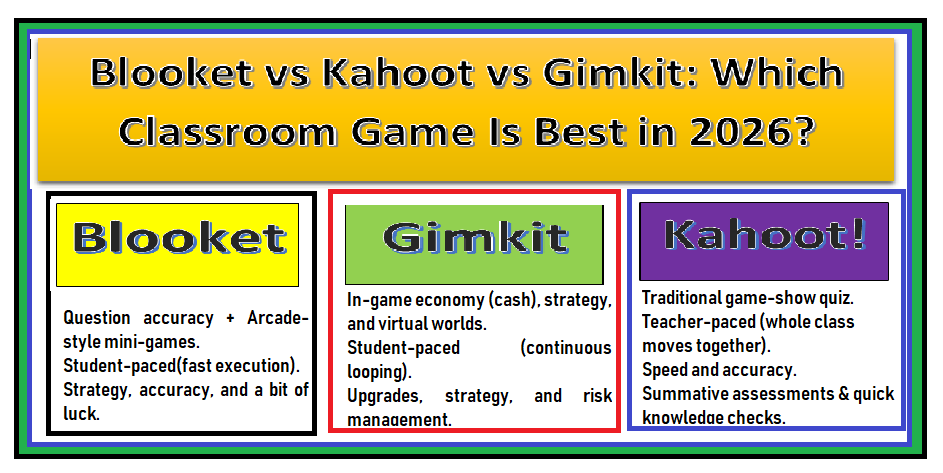
Educational games have become a popular way to make classroom learning more interactive, encourage participation, and help students revise difficult concepts. Instead of relying entirely on traditional quizzes, teachers can use game-based learning platforms to turn questions into engaging activities. Three popular options are Blooket, Kahoot, and Gimkit, but each platform offers a different learning experience.
If you are searching for Blooket vs Kahoot, Blooket vs Gimkit, or the best classroom quiz games, this guide compares their game modes, classroom features, homework options, ease of joining, and teacher tools. Whether you are a teacher planning a revision session or a student looking for an engaging way to study, understanding these differences can help you choose the right platform.
What Are Blooket, Kahoot, and Gimkit?
What Is Blooket?
Blooket is an educational gaming platform that combines question-based learning with different game mechanics. Teachers can create or discover question sets and use them in activities featuring challenges, rewards, competition, and progression. Instead of repeating the same quiz format, students can answer questions while participating in different types of games.
One of Blooket’s main attractions is its variety of game modes. According to its official Help Center, the platform offers more than 25 modes across live, solo, and homework experiences, although some modes and features require a paid plan. Teachers can use Blooket for classroom revision, independent practice, and homework assignments.
Official website: https://www.blooket.com/
What Is Kahoot?
Kahoot is an interactive learning platform known for its quiz-based games, colorful interface, and classroom competitions. Teachers display questions to students, who submit their answers using their own devices. Depending on the selected format, questions can be answered individually, in teams, or at each student’s own pace.
Kahoot also supports question creation, polls, puzzles, presentations, assigned activities, and learning reports. Its familiar quiz format makes it useful for introducing a topic, checking understanding, reviewing lessons, and collecting feedback during a class.
Official website: https://kahoot.com/
What Is Gimkit?
Gimkit is a classroom learning platform that combines question answering with strategy and in-game rewards. Students earn virtual money by answering questions correctly and can use their earnings to purchase upgrades and power-ups in supported game modes. This creates a different experience from a conventional multiple-choice quiz.
Gimkit also offers multiple game modes, teacher-created question sets called Kits, classroom reports, and independent assignments through its paid Pro plan. Its emphasis on strategy and repeated question practice makes it an interesting option for students who enjoy working toward goals while reviewing academic material.
Official website: https://www.gimkit.com/
Blooket vs Kahoot vs Gimkit: Quick Comparison
The following table summarises the main differences between these three educational platforms.
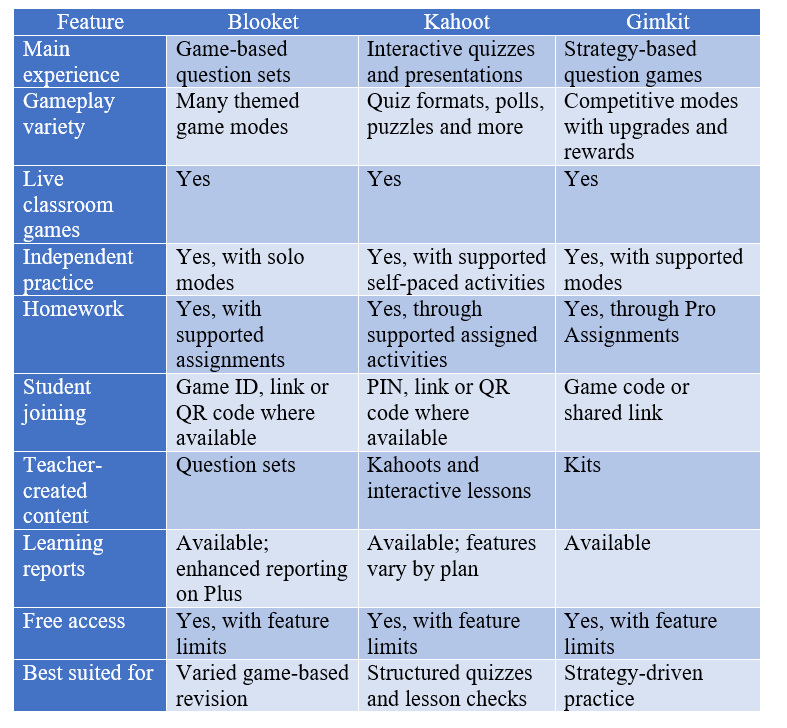
Features, player limits, and plan restrictions may change. Check each platform’s official website for current availability.
1. Blooket vs Kahoot: Which Offers Better Gameplay?
The biggest difference between Blooket and Kahoot is how students interact with questions.
Blooket combines academic questions with themed gameplay. Students might answer questions while progressing through a challenge, collecting rewards, defending resources, or competing against classmates, depending on the selected mode. This variety can make repeated revision sessions feel different even when the underlying questions remain the same.
Kahoot places greater emphasis on the quiz experience. Teachers can host live competitions, display questions on a shared screen, introduce information through slides, and use different question formats to check understanding. Its straightforward structure is particularly useful when the teacher wants to introduce a topic, assess recall, or review a lesson with the entire class.
1. Which is better?
Choose Blooket if you want to vary gameplay and make repeated question practice feel like a collection of different activities. Choose Kahoot if you prefer a structured quiz experience that fits naturally into a presentation or whole-class discussion.
Neither platform is automatically better for learning. The more suitable option depends on the students’ age, the lesson objectives, and whether the activity is intended for revision, assessment, or engagement.
2. Blooket vs Gimkit: Which Is More Engaging?
Blooket and Gimkit both combine academic questions with game mechanics, but their approaches differ.
Blooket offers a broad range of themed modes. Depending on the game, students may collect items, compete with other players, manage resources, or progress through different challenges. Teachers can reuse a question set across supported modes, allowing the same academic content to support different classroom activities.
Gimkit builds its experience around earning in-game money and using it strategically. Students answer questions to earn rewards and can spend those rewards on upgrades in supported modes. Because students may encounter questions repeatedly, Gimkit can be useful for practice sessions where repetition and progression are part of the learning objective.
Which is better?
Blooket may be the better fit when you want a wide selection of different game experiences. Gimkit may be more suitable when students enjoy strategy, resource management, and working toward in-game goals.
Teachers should also consider whether the gameplay encourages students to focus on the learning material. A highly entertaining activity is most effective when its questions, difficulty, and rewards support the intended educational outcome.
3. Which Platform Has the Best Game Modes?
Game modes are an important consideration because they influence how students interact with questions and classmates.
Blooket has a particularly broad selection of modes. Some emphasize direct competition, while others introduce resource management, progression, or individual challenges. This variety can help teachers change the format of a revision activity without necessarily creating an entirely new question set.
Kahoot offers several ways to present and answer questions, including quizzes, polls, puzzles, word clouds, open-ended responses, and interactive presentations, depending on the available plan and activity type. These features are useful when a teacher needs more than a simple right-or-wrong quiz.
Gimkit uses modes that build on its reward-based gameplay, although the available selection depends on the account plan and current free-mode rotation. The platform is especially appealing to students who like earning resources and making strategic decisions while practicing.
For teachers, the best game mode is not necessarily the one with the most features. It is the one that supports the learning objective, keeps students participating, and provides enough opportunities to answer meaningful questions.
4. Which Is Best for Homework and Independent Study?
Homework support is another important difference between Blooket, Kahoot, and Gimkit.
Blooket allows teachers to assign supported solo game modes as homework. Students can complete activities independently, and teachers can set deadlines according to the features available on their plan. This makes it useful for additional revision outside the classroom.
Kahoot supports student-paced activities and assigned learning experiences. Teachers can share activities for independent completion, adjust supported settings, and use reports to review student performance. Depending on the plan, Kahoot also offers more structured learning experiences through courses and other assignment features.
Gimkit provides independent assignments through Gimkit Pro. Teachers choose a compatible game mode, configure the assignment goals, and share the assignment link with students. This can be useful for distance learning, independent practice, and homework that uses game-based progression.
Best choice for homework: All three platforms can support learning outside the classroom, but their assignment features differ. Blooket offers solo game options, Kahoot supports assigned and self-paced activities, and Gimkit Pro provides dedicated assignments with configurable goals.
Before choosing a platform, consider whether you need deadlines, detailed performance reports, independent student access, or particular game modes. Some features require a paid subscription.
5. Which Platform Is Easiest for Students to Join?
Ease of access matters when a teacher needs an entire class to begin an activity quickly.
Joining Blooket
Students can visit the official joining page, enter the game ID provided by their teacher, and follow the instructions on screen. A shared link or QR code may also be available. Students generally do not need an account to join a live game.
Visit: https://play.blooket.com/
Joining Kahoot
Students typically join a live Kahoot session using the PIN, link, or QR code provided by the host. They follow the joining instructions and enter a nickname or other requested information. The exact steps can vary with the host’s settings and the activity type.
Visit: https://kahoot.it/
Joining Gimkit
Students can join a live Gimkit session using the game code or link shared by the teacher. They follow the on-screen instructions to enter the session. Students do not need to create accounts to participate in live games or complete supported assignments.
Visit: https://www.gimkit.com/
Which is easiest to join?
All three platforms offer relatively straightforward joining methods. In practice, the easiest one is often the platform your students already know how to use. Network restrictions, browser problems, host settings, and account requirements for specific features can also affect the experience.
6. Which Platform Has Better Teacher Features?
Teachers need more than engaging games. They may also need to prepare questions, reuse materials, monitor participation, and evaluate student understanding.
Blooket lets teachers create or discover question sets and reuse them across supported game modes. Its paid Plus plan includes additional capabilities such as enhanced reports, question-bank features, and larger live games. These options can be useful for teachers who want more detailed reporting or additional classroom flexibility.
Kahoot provides tools for creating quizzes and interactive lessons, using existing question content, sharing activities, and reviewing reports. Teachers can also use polls and other question formats to collect feedback and check understanding. Available features and player limits depend on the subscription plan.
Gimkit lets teachers create Kits, host games, organize classes, and review reports. Its Pro plan adds features such as assignments, additional game modes, and image or audio question options. These tools can support teachers who want to combine repeated practice with independent assignments.
The most suitable teacher toolkit depends on the type of instruction you deliver. For a quick classroom check, a simple quiz may be enough. For ongoing revision, homework, or more detailed progress monitoring, compare the reporting and assignment features included in each platform’s current plan.
7. Blooket vs Kahoot vs Gimkit: Pricing and Free Features
All three platforms offer free access, but their free plans do not include every feature.
Blooket’s free Starter plan supports creating and discovering question sets and playing supported game modes. Blooket Plus unlocks additional features, including certain game modes, enhanced reporting, and larger live-game capacity.
Kahoot has a free option, along with paid plans for different types of users. Depending on the plan, paid features can include additional question types, larger player limits, more customization, advanced reports, and expanded teaching tools.
Gimkit Basic provides free educator access for hosting games, creating classes, and collecting reports. Gimkit Pro adds features such as assignments, Pro-exclusive game modes, and audio and image questions. Gimkit’s official help information identifies assignments as a paid Pro feature.
Prices and plan names can change, so it is best to check the official pricing pages before making a decision:
- Blooket: https://www.blooket.com/
- Kahoot: https://kahoot.com/schools/plans/
- Gimkit: https://www.gimkit.com/group/pricing
For teachers working with limited budgets, start by testing each free plan against your classroom requirements. A paid subscription is worthwhile only if its additional features solve a genuine teaching need.
8. Which Is Best for Different Subjects and Age Groups?
The best classroom quiz platform can vary depending on the subject, the students’ age, and the learning goal.
For mathematics and science, teachers can use all three platforms for formula revision, terminology, conceptual questions, and short problem-solving checks. Blooket and Gimkit can add game-based progression to repeated practice, while Kahoot can be useful for reviewing concepts and discussing answers with the class.
For language learning, Kahoot’s range of question formats can support vocabulary checks, comprehension, and discussion. Blooket and Gimkit can also make vocabulary and grammar revision more interactive.
For younger learners, teachers may prefer activities with clear instructions, manageable question difficulty, and an interface suited to the class. Older students may enjoy more complex challenges or strategic gameplay, but preferences differ among individuals.
Rather than selecting a platform based only on age, test a short activity and observe whether students can join easily, understand the instructions, answer the questions, and stay focused on the learning objective.
9. Advantages and Limitations of Each Platform
Blooket
Advantages: A wide range of themed game modes, reusable question sets, solo practice, and supported homework activities.
Limitations: Some modes and advanced teacher features require a paid plan. The variety of gameplay may also distract students if the activity is not well matched to the lesson.
Kahoot
Advantages: Familiar live quiz format, interactive presentations, multiple question formats, assigned activities, and reporting tools.
Limitations: Some question types, player limits, and advanced features depend on the subscription. Competitive timers and leaderboards may not suit every classroom or every student.
Gimkit
Advantages: Strategy-based gameplay, in-game rewards, repeated question practice, teacher reports, and dedicated homework assignments on Pro.
Limitations: Assignments and some game modes require a paid subscription. The in-game economy may take additional explanation for students who are unfamiliar with its mechanics.
Each platform can be useful when teachers select the right activity and maintain a clear connection between gameplay and learning.
10. Which Classroom Game Should You Choose?
The right choice depends on what you want your students to accomplish.
Choose Blooket if your priority is variety in game-based revision and you want to reuse question sets across different activities.
Choose Kahoot if you want a familiar live quiz format, interactive presentations, quick knowledge checks, and a range of ways to collect student responses.
Choose Gimkit if you want students to combine question practice with strategic decisions, in-game rewards, and structured independent assignments through its Pro plan.
If you are unsure, try the same set of questions on each platform and compare student participation, ease of access, time spent answering, and the quality of the learning results. That provides a more meaningful comparison than choosing solely by popularity.
Frequently Asked Questions
Is Blooket better than Kahoot?
Blooket may be a better choice for teachers who want varied themed gameplay and multiple ways to reuse question sets. Kahoot may be better for structured quizzes, interactive presentations, and classroom feedback. The better option depends on your teaching objectives.
Is Blooket better than Gimkit?
Blooket offers a broad selection of themed game modes, while Gimkit emphasizes strategy and reward-based progression. Both support question-based learning and independent practice. Choose according to the gameplay and teacher features that suit your class.
Which is the best classroom quiz game in 2026?
Blooket, Kahoot, and Gimkit are all useful classroom learning platforms. Blooket is worth considering for varied game-based revision, Kahoot for interactive quizzes and presentations, and Gimkit for strategy-driven practice. There is no single best platform for every classroom.
Can students use these platforms for free?
Yes, all three offer free access, although their features, player limits, and assignment options vary. Teachers should check current plan details to determine whether the free version meets their needs.
Which platform is best for homework?
Blooket supports homework through selected game modes, Kahoot offers assigned and self-paced activities, and Gimkit Pro provides dedicated assignments. Compare the available deadlines, reports, and plan requirements before deciding.
Do students need accounts to join games?
Students can generally join live games on Blooket, Kahoot, and Gimkit using the host’s joining instructions without creating their own accounts. Specific activities and account-related features may have different requirements, so follow the instructions provided by the teacher.
Final Verdict
The comparison of Blooket vs Kahoot vs Gimkit shows that these platforms serve similar educational goals through different approaches to game-based learning. Blooket emphasizes variety in themed gameplay, Kahoot focuses on interactive quizzes and presentations, and Gimkit combines question practice with strategy and rewards.
For teachers, the best choice is the one that makes learning objectives clear, encourages meaningful participation, and fits the available budget and classroom setup. For students, it is the platform that makes practice enjoyable without losing sight of what they need to learn.
Explore each platform’s official features, try a short classroom activity, and choose the tool that works best for your students.
Also read here: