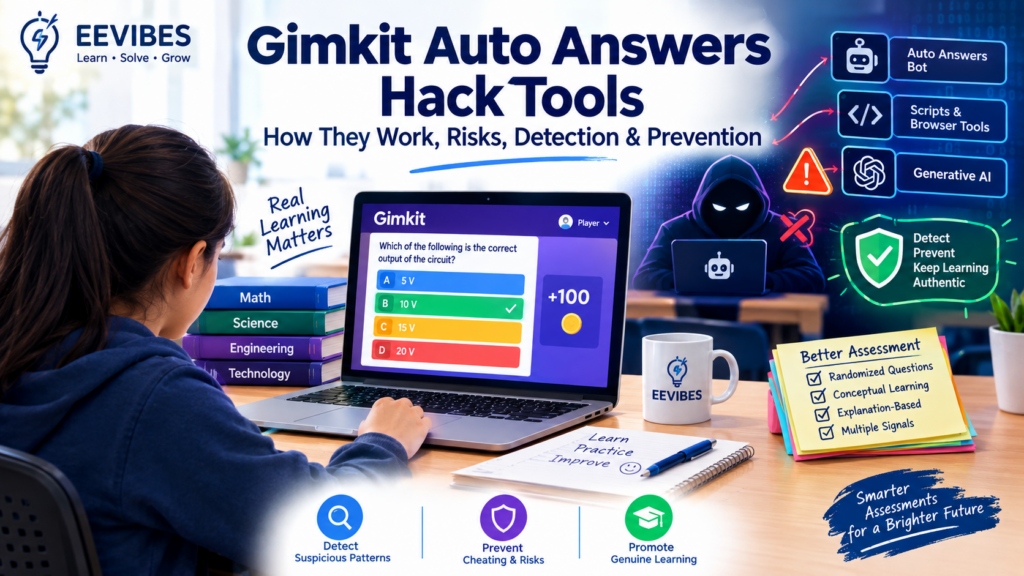
Gamified learning platforms have changed the way students interact with quizzes. Instead of simply answering questions on a worksheet, students can compete for points, virtual currency, upgrades, rewards, and leaderboard positions. Gimkit is one example of this approach, combining assessment with game mechanics to make classroom activities more interactive.
However, whenever learning becomes competitive and digital, a familiar problem appears: some users try to automate the process.
Searches for terms such as “Gimkit auto answers”, “Gimkit answer bot”, “Gimkit hack tools”, and “Gimkit cheats” lead to scripts, browser tools, and repositories claiming to automate answers or manipulate gameplay. Public repositories have historically advertised features such as automatic answering, answer highlighting, and game-state manipulation. Some of these projects are outdated or broken, while others may attempt to interact directly with the game’s browser session.
The important question for educators is therefore not simply “Do Gimkit hacks exist?” but rather:
How can teachers recognise automated behaviour and design assessments that remain meaningful when students have access to bots, scripts, and generative AI?
What Is a Gimkit Auto-Answer Tool?
A Gimkit auto-answer tool is software designed to reduce or eliminate the need for a student to manually solve and answer questions.
At a high level, an automated system may attempt to:
- Detect the question displayed in the browser.
- Identify possible answer choices.
- Match the question against information available to the tool.
- Determine a candidate answer.
- Submit the response automatically.
- Repeat the process for subsequent questions.
This is fundamentally different from an accessibility tool or legitimate study aid. The distinguishing characteristic is automation of the assessment response without the learner performing the intended cognitive task.
Some publicly available projects describe automatic-answer functionality and browser-based interaction with Gimkit. Their documentation also shows that such tools can break when the platform changes its interface or technical architecture.
Figure 1 — Conceptual Architecture of an Auto-Answer Attack
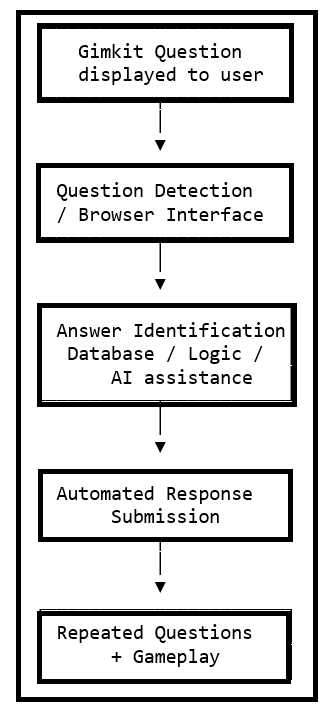
This diagram is intentionally conceptual. Understanding the architecture helps educators recognise suspicious behaviour without turning the explanation into a recipe for circumventing platform safeguards.
Why Are Auto-Answer Tools Attractive?
Gamified platforms introduce rewards for successful participation. In Gimkit, for example, correct answers can influence progression and game resources.
That creates an interesting cybersecurity problem:
The learning objective and the game objective can become separated.
A student may appear to perform extremely well because the system is producing correct answers, even though the student has not demonstrated equivalent knowledge.
Auto-Answer Bots vs. Generative AI
Modern academic-integrity problems are no longer limited to traditional scripts.
There are at least three broad categories of automation that educators should consider:
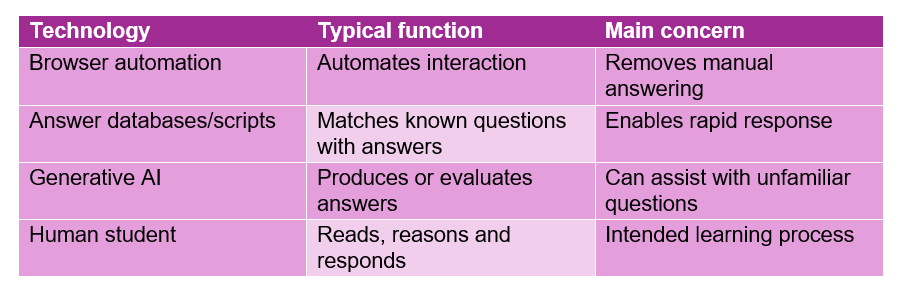
Generative AI introduces a different challenge.
A conventional answer bot may depend on a known question or answer set. A generative AI-assisted system may potentially handle questions it has not previously encountered by interpreting the question and producing an answer.
That means question randomisation alone is not necessarily a complete defence against modern AI-assisted cheating.
Figure 2 — The Changing Assessment Threat
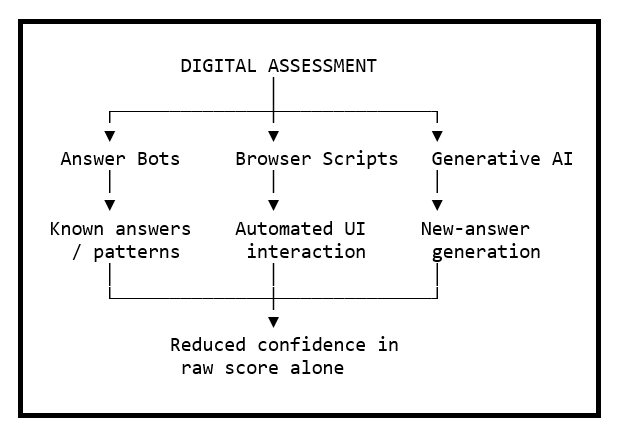
The key lesson is that a high score is not automatically equivalent to high learning.
What Do These Tools Actually Exploit?
It is useful to think of automated cheating as an interaction between three layers.
1. The Interface Layer
The browser displays questions, answer choices, timers, scores, and game information.
Automation may attempt to interact with these visible elements.
2. The Communication Layer
Modern web applications communicate continuously with servers. Gimkit’s own technical documentation discusses its use of secure WebSocket connections for real-time gameplay.
This real-time architecture is important because classroom games need rapid communication between players and servers.
3. The Assessment Layer
The platform ultimately receives information about questions, responses, timing, and game progress.
The challenge for an educational platform is therefore to distinguish:
“A student answered quickly.”
from
“A program produced a sequence of responses that is inconsistent with normal human behaviour.”
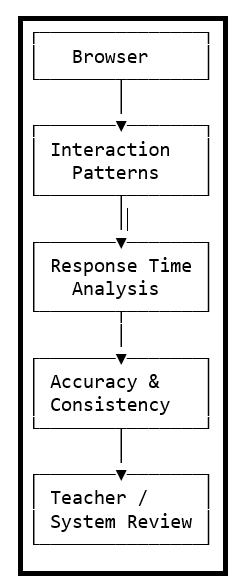
Figure 3 — Where Detection Can Occur
Can Teachers Detect Gimkit Auto Answers?
Yes, suspicious behavior can sometimes be identified through behavioral patterns, although no single metric proves that a student has cheated.
Gimkit’s own guidance suggests looking at several signals, including the student’s question-by-question performance, whether they make mistakes, how quickly assignments are completed, unexpected accuracy, and whether performance changes substantially when the student is being observed.
This is an important principle:
Detection should be based on multiple signals rather than one unusually high score.
Important Detection Signals
1. Extremely High Accuracy
A student who suddenly moves from average performance to nearly perfect performance may deserve additional attention.
However, accuracy alone is weak evidence.
A student may genuinely improve after studying.
Therefore:
High accuracy ≠ automatic proof of cheating.
2. Unusually Consistent Response Timing
Human responses usually vary.
Some questions require more reading. Others require calculations or recall.
An automated process can potentially produce unusually regular timing.
For example:
Human-like pattern
Q1 → 2.8 s
Q2 → 6.1 s
Q3 → 3.4 s
Q4 → 9.2 s
Q5 → 4.7 s
Potentially suspicious pattern
Q1 → 1.1 s
Q2 → 1.0 s
Q3 → 1.1 s
Q4 → 1.0 s
Q5 → 1.1 s
This does not mean that identical timing proves automation. Network latency, question difficulty, accessibility settings, and other factors can influence response times.
It is better viewed as a signal requiring context.
3. Sudden Performance Changes
Historical performance can provide useful context.
Suppose a student’s previous results look like:
Assessment 1 68%
Assessment 2 71%
Assessment 3 74%
Assessment 4 98%
The jump is interesting, but it should not automatically be interpreted as misconduct.
Teachers can compare:
- previous assessments
- question difficulty
- preparation time
- response speed
- classroom observation
- written explanations
- ability to solve similar questions independently
Gimkit specifically recommends examining drastic improvements and unusually fast completion when investigating suspected cheating.
4. Performance Under Observation
One particularly useful educational technique is to compare performance across different conditions.
For example:
Online Game
│
▼
Very high performance
│
▼
Follow-up teacher discussion
│
▼
Can student explain the answers?
│
┌─┴─┐
YES NO
│ │
▼ ▼
Evidence Requires
of actual further
learning investigation
Again, this should be treated as diagnostic evidence, not automatic proof of misconduct.
Why Auto-Answer Tools Are Unreliable
Ironically, many tools marketed as “Gimkit hacks” are themselves unreliable.
Public repositories document problems caused by changing interfaces, unsupported modes, question variations, and platform-side changes. One repository, for example, notes that visual answer detection can produce incorrect results when questions are identical or similar.
Other publicly available projects have explicitly become unmaintained or describe their tools as broken.
This creates a simple cycle:
Platform changes
↓
Old automation breaks
↓
Tool developers modify scripts
↓
Platform introduces additional changes
↓
Automation becomes unreliable
↓
Cycle repeats
For students, this means a tool advertised as “working” on one website or video may not actually work reliably.
The Security Risks Go Beyond Cheating
Using unofficial browser scripts can introduce additional risks.
Students may be encouraged to paste unknown JavaScript into browser developer tools or install unverified extensions.
That creates a separate cybersecurity concern:
The student may be giving third-party code access to their browser environment.
The risks can include:
- malicious JavaScript
- credential theft
- unwanted browser modifications
- tracking
- account compromise
- malicious extensions
- fake “hack” downloads
- phishing pages
- malware disguised as cheat tools
Therefore, a supposed “free auto-answer tool” should not automatically be considered harmless simply because it claims to be an educational hack.
Gimkit’s Own Rules Matter
Gimkit’s Creative community rules explicitly prohibit creating games involving cheating, exploits, or scams.
Gimkit also provides educators with tools for managing gameplay. For example, its game options allow teachers to customize game behavior, while its Quick Actions can allow hosts to remove players from a game when necessary.
These features are more useful to educators than trying to chase individual cheat scripts across the internet.
How Teachers Can Reduce Auto-Answer Abuse
1. Use Question Randomization
Avoid relying exclusively on a small static collection of questions.
Different students can receive different:
- question orders
- numerical values
- examples
- distractors
- scenarios
This makes simple answer databases less useful.
2. Use Conceptual Questions
Instead of asking only:
What is the definition of X?
Ask:
A student encounters situation Y. Which principle explains the observed result?
Conceptual questions require more than memorization.
Generative AI Changes the Game
The emergence of generative AI makes assessment design even more important.
Traditional cheating tools often attempt to automate a known process. Generative AI can potentially help produce answers to questions that were not previously stored in an answer database.
This means educators increasingly need to distinguish between:
answer production and learning evidence.
A student may be able to obtain a correct answer without demonstrating the reasoning behind it.
For engineering, mathematics, programming, and science courses, this distinction is particularly important.
For example, instead of asking only:
Calculate the output voltage.
A stronger assessment may ask:
Calculate the output voltage, explain which equation you selected, identify one assumption in your calculation, and explain how the answer would change if the input resistance doubled.
The second task produces richer evidence of understanding.
What Should Students Do Instead?
Students who encounter a difficult Gimkit question have much more to gain from using the platform as intended.
Instead of searching for an auto-answer tool, students can:
- review incorrect answers
- build flashcards
- practice similar questions
- ask the teacher for clarification
- use legitimate study resources
- discuss concepts with classmates
- use AI as a tutor when permitted
- practice explaining the answer themselves
The difference is fundamental:
Using technology to learn is different from using technology to impersonate learning.
A Note for Parents and Teachers
Parents and educators should also be careful about labeling a student a “cheater” based solely on unusual statistics.
A student might answer quickly because:
- they already know the material
- the questions are familiar
- they have accessibility tools
- they have practiced extensively
- the questions are easy
- they have misunderstood the assessment
- technical conditions affected timing
Consequently, suspicious patterns should trigger investigation and conversation, not an automatic accusation.
The Future of Gamified Learning
The future of classroom gaming is unlikely to be completely free from bots, scripts, automation, or generative AI.
Instead, educational technology will increasingly need to assume that students have access to powerful computational tools.
That changes the central question.
The question is no longer:
“How do we make cheating technically impossible?”
A more useful question is:
“How do we design learning experiences where automated answers provide little advantage over genuine understanding?”
That shift is important.
A well-designed assessment should reward:
- reasoning
- explanation
- application
- creativity
- problem solving
- conceptual understanding
- transfer of knowledge
rather than merely rewarding the fastest click.
Conclusion
Gimkit auto-answer hack tools represent a broader challenge facing digital education: the growing gap between producing an answer and demonstrating learning.
Publicly available scripts have shown that browser automation and answer-assistance tools can interact with gamified quiz platforms, although many are unreliable, outdated, or incompatible with platform changes.
For educators, the solution is not simply to identify every new “Gimkit hack.” Instead, effective assessment security combines:
behavioral monitoring + thoughtful question design + teacher observation + explanation-based assessment + responsible technology use.
Gamification remains powerful because it can make learning engaging. The goal should be to preserve that engagement while ensuring that the points, rewards, and leaderboards continue to represent learning rather than automation.
Key Takeaways
- Auto-answer tools attempt to automate responses rather than support genuine learning.
- Public repositories demonstrate that such tools have existed, but many are unreliable or outdated.
- Unusually high accuracy should be considered alongside timing and historical performance.
- No single behavioral signal proves cheating.
- Generative AI creates a broader assessment challenge than traditional answer bots.
- Teachers can reduce abuse through randomized, conceptual, and explanation-based questions.
- Unverified cheat tools can introduce cybersecurity risks.
- The strongest defense is not only technical detection but assessment design that measures understanding.