Introduction
For years, software has helped people work faster. We have used spreadsheets to calculate, databases to organize information, search engines to find answers, and automation tools to handle repetitive tasks. But a new generation of software is changing the relationship between people and computers in a much more fundamental way: AI software bots can increasingly understand a goal, decide what steps are needed, use digital tools, and carry out tasks with limited human intervention.
These systems are often described using terms such as AI agents, intelligent agents, autonomous agents, or AI-powered bots. While the terminology is still evolving, the underlying idea is relatively simple. Instead of requiring a person to tell software exactly what to do at every step, an AI bot can be given an objective and can determine at least some of the steps required to achieve it.
Imagine a small business owner who receives dozens of customer emails every morning. Traditionally, the owner or an employee might read each message, identify the customer’s request, search an internal system, prepare a response, update a record, and move on to the next email. An AI software bot could potentially perform much of that workflow itself while escalating unusual or sensitive cases to a human.
That shift is important because it changes AI from something people merely consult into something that can sometimes participate in the work itself.
The technology is not magic, and it is not a replacement for human judgement in every situation. AI bots can make mistakes, misunderstand instructions, expose sensitive information, or take an inappropriate action if they are poorly designed. Their real value therefore comes not simply from making them autonomous but from designing the right balance between automation, oversight, accountability, and human judgement.
1. What Is an AI Software Bot?
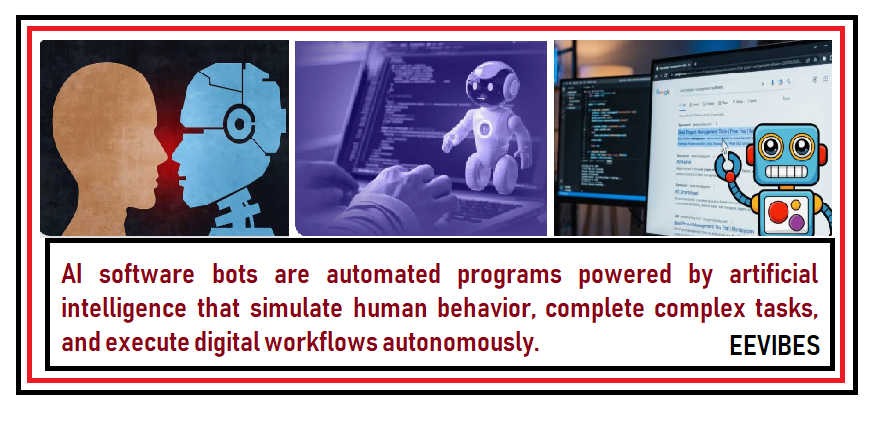
An AI software bot is a software system that uses artificial intelligence to perceive information, interpret instructions, reason about possible actions, and perform one or more tasks through digital systems.
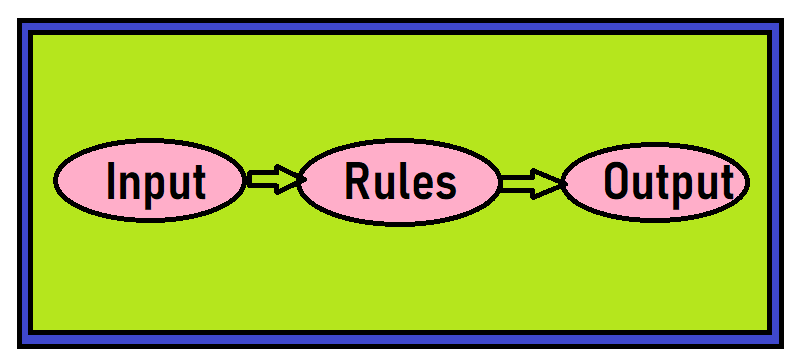
Traditional software generally follows explicitly programmed rules:
An AI software bot can operate through a more flexible process:
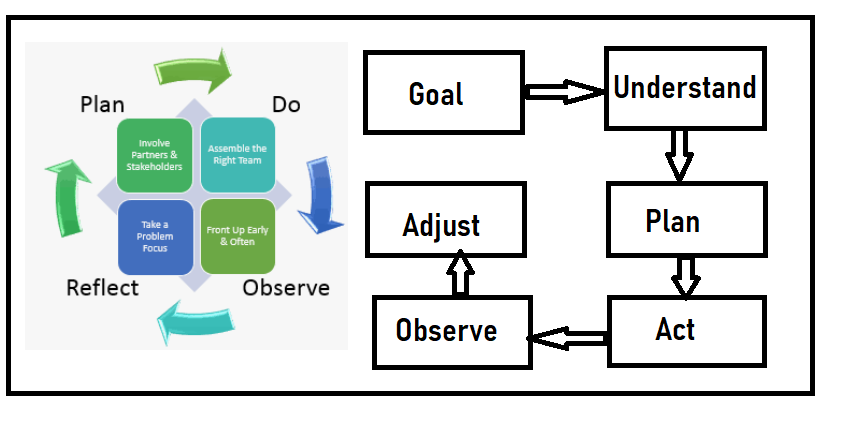
This difference may appear subtle, but it has major implications.
A conventional automation might be programmed to move every email containing the word “invoice” into a particular folder. An AI bot could potentially read the message, understand that the sender is asking about a missing invoice, examine relevant records, determine what information is available, and draft an appropriate response.
The bot is therefore not merely following one predefined instruction. It is interpreting a situation and selecting actions within a defined environment.
Figure 3: Traditional Automation vs. AI Software Bot
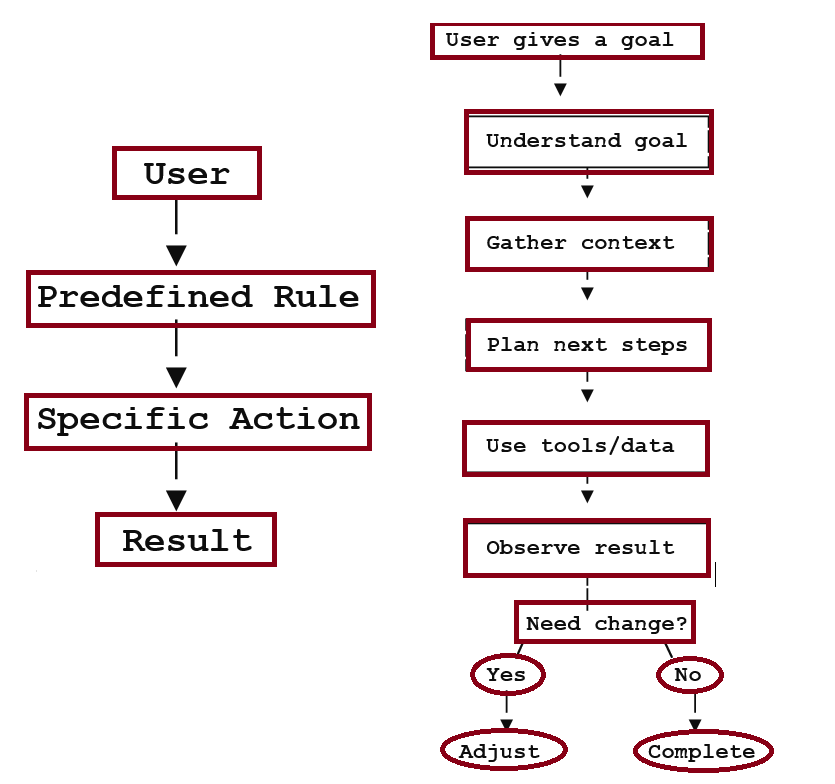
The important point is that an AI software bot does not necessarily need to be completely autonomous. In many practical environments, the most useful systems are semi-autonomous: they handle routine work independently but ask a human to intervene when the situation becomes uncertain or consequential.
2. How AI Software Bots Work
Although implementations vary considerably, many AI bots contain several conceptual components.
The first is an AI model, often a large language model or another machine-learning model. This component helps the system understand natural language, interpret information, generate content, reason through problems, or decide what action might be appropriate.
The second component is context. A bot needs information about the task it is performing. This might include a conversation, company documentation, customer records, a database, files, or information retrieved from an external system.
The third component is a tool layer. A bot becomes considerably more useful when it can interact with software rather than simply produce text. Tools may allow it to search a database, send an email, create a calendar event, retrieve information from an API, update a record, execute a calculation, or interact with another application.
Finally, there is an orchestration and control layer that determines what the bot is allowed to do, how actions are executed, and when human approval is required.
Figure 4: Anatomy of an AI Software Bot
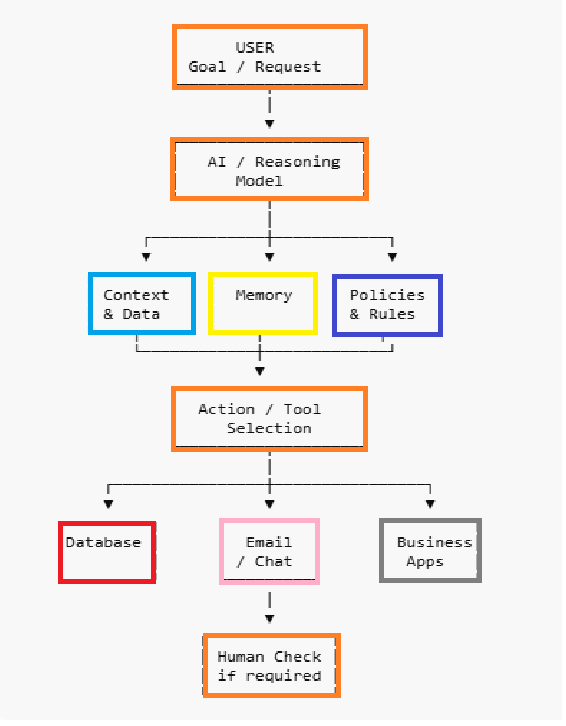
This architecture explains why AI software bots are more than chatbots. A chatbot may primarily communicate with a user. An AI bot designed as an agent can potentially communicate, reason, retrieve information, use tools, and take actions.
3. AI Bots vs. Traditional Bots vs. Chatbots
The term “bot” covers a wide range of technologies, so it is useful to distinguish between them.
A traditional software bot typically follows predetermined instructions. Web crawlers, automated monitoring scripts, and rule-based customer-service bots are examples.
A chatbot focuses primarily on conversation. It receives a message and generates a response.
An AI software bot can go further by combining conversation with reasoning and actions.
Consider a travel request:
“Find me a suitable flight for next week and add the trip to my calendar.”
A simple chatbot might respond with general travel information.
A traditional automation might execute a fixed search workflow.
A more capable AI software bot could interpret the request, determine the relevant dates, search for an available service, compare results according to the user’s stated preferences, present options, and—if authorised—complete the booking and update the calendar.
The distinction is therefore less about whether a system “uses AI” and more about what the system can actually do.
4. The Evolution of Software Bots
AI software bots did not appear overnight. They represent the convergence of several technological developments.
Early bots were primarily rule-based. They could perform repetitive actions but had little ability to understand ambiguous human instructions.
The growth of machine learning enabled systems to identify patterns in data.
Natural-language processing made it possible for software to understand human language with increasing sophistication.
Large language models then dramatically improved a computer’s ability to interpret open-ended instructions and generate useful responses.
The next step has been connecting these models to tools and external systems.
Figure 5: Evolution of Software Automation
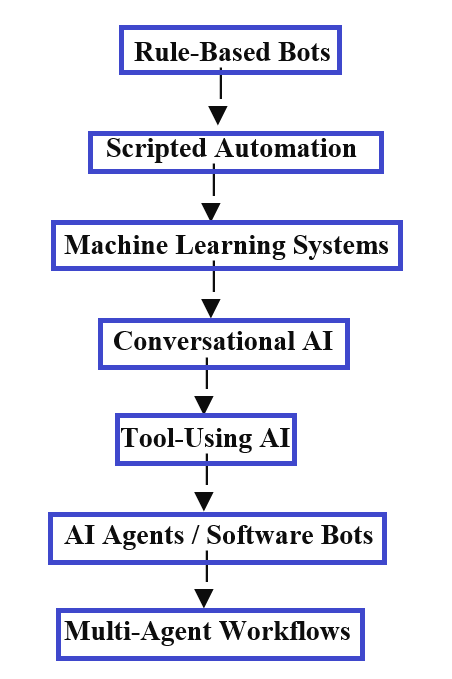
This evolution represents a movement from software that executes instructions toward software that can increasingly interpret objectives and coordinate actions.
5. Where AI Software Bots Are Being Used
The potential applications are broad because almost every organisation contains repetitive information-based processes.
Customer Service
Customer-service bots can classify requests, retrieve relevant information, draft responses, summarise conversations, and route complicated cases to human representatives.
A useful implementation does not necessarily attempt to eliminate human support. Instead, it can remove some of the repetitive work that prevents human representatives from concentrating on unusual or emotionally sensitive cases.
For a customer whose delivery is late, for example, the bot might retrieve the order status automatically. If the customer has an unusual complaint involving a refund or dispute, the system can transfer the case to a person with the relevant context already attached.
Software Development
AI software bots are increasingly being used throughout development workflows. They can help developers understand code, generate routine code, explain errors, create tests, review changes, and investigate documentation.
The human developer remains important because software development involves architecture, security, product requirements, trade-offs, and accountability that cannot simply be reduced to generating code.
Business Operations
Businesses contain countless repetitive workflows:
-
Processing documents
-
Extracting information from invoices
-
Preparing reports
-
Updating databases
-
Categorizing requests
-
Monitoring routine processes
-
Preparing meeting summaries
-
Generating internal documentation
AI bots can potentially connect several of these steps into a single workflow.
Sales and Marketing
A sales-oriented bot might research a prospective company, summarize publicly available information, prepare a briefing, update a customer relationship management system, and draft a personalized message.
The challenge is ensuring that automation does not turn personalization into mass-produced spam. Human oversight and clear communication remain important.
Research and Knowledge Work
Researchers and analysts spend considerable time searching, organizing, comparing, and summarizing information.
AI bots can assist by gathering information from approved sources, extracting relevant details, organizing findings, and producing preliminary summaries.
However, research-oriented bots need strong verification mechanisms because an impressive-looking answer is not necessarily an accurate one.
6. A Practical Example: The AI Finance Assistant
Consider a hypothetical company that receives hundreds of invoices every month.
Without automation, an employee may need to:
-
Open an invoice.
-
Identify the supplier.
-
Extract the amount.
-
Check the purchase order.
-
Determine whether the invoice is legitimate.
-
Enter information into an accounting system.
-
Route unusual invoices to a manager.
7. Why Businesses Are Interested in AI Software Bots
The attraction is straightforward: organizations want to accomplish more without making every employee spend their day performing repetitive digital tasks.
An AI bot can potentially work continuously, process large quantities of information, and operate across multiple applications.
But productivity is only one part of the story.
AI bots may also reduce the friction involved in accessing organizational knowledge. Instead of searching through several systems, an employee could potentially ask an AI system to gather the necessary information and present it in a usable form.
This can change the employee experience.
Someone who previously spent an hour preparing a report might spend more time interpreting the report and deciding what to do about it.
That distinction matters because technology creates value not simply when it makes tasks faster, but when it gives people more time for work that requires judgment, creativity, empathy, communication, and responsibility.
8. The Human Side of AI Bots
The conversation around AI automation often becomes overly technical. We talk about models, APIs, tokens, tools, context windows, and benchmarks.
But behind every automated workflow is a person.
There is an employee who may be relieved because an AI system has removed hours of repetitive work. There is also an employee who may worry that the same system could eventually change their role.
There is a customer who appreciates receiving an answer immediately. There is another customer who becomes frustrated when an automated system cannot understand an unusual situation.
This is why implementing AI software bots is fundamentally a human problem as much as a technical one.
Organizations need to ask questions such as:
-
Which tasks should be automated?
-
Which decisions should remain human?
-
What happens when the AI is uncertain?
-
Who is responsible when an automated action causes harm?
-
How can employees understand what the system is doing?
-
How should customers know when they are interacting with AI?
-
What information should the system be allowed to access?
A technically impressive bot can still be a poor solution if it creates confusion, removes necessary human contact, or introduces risks that outweigh its benefits.
9. The Risks and Limitations
AI software bots can be powerful, but they are not infallible.
Incorrect Information
AI systems can produce incorrect information with considerable confidence. A bot that retrieves information incorrectly or interprets it poorly can create downstream problems.
Excessive Autonomy
Giving a system permission to send messages, modify records, make purchases, or execute transactions creates risks if the system misunderstands its instructions.
The more consequential the action, the more important authorization and verification become.
Security
An AI bot may have access to sensitive information and powerful software tools. Poorly designed permissions can therefore create significant security problems.
A useful principle is:
Give the bot only the access it actually needs.
Privacy
Organizations need to consider what data an AI bot can access, where that information is processed, how it is retained, and who can retrieve it.
10. Hallucinations and Reasoning Errors
Even when an AI system appears sophisticated, it can misunderstand context or produce unsupported conclusions.
This is especially important in environments where accuracy is critical.
Over-Automation
Not every human interaction should become automated.
A customer dealing with a sensitive problem may need empathy rather than efficiency. An employee facing an unusual situation may need a knowledgeable colleague rather than another automated interface.
The goal should therefore be appropriate automation, not maximum automation.
11. AI Bots and the Future of Work
The future of AI software bots is unlikely to be defined simply by a choice between “humans” and “machines.”
A more realistic possibility is that workplaces will contain teams made up of people and software systems working together.
An employee might begin the morning by asking an AI assistant to summarize overnight activity. The assistant could identify unusual events, gather relevant information, and prepare a list of issues requiring attention.
During the day, the employee might delegate routine research to one bot, document processing to another, and reporting to a third system.
The employee would still make decisions, communicate with colleagues, understand customers, negotiate priorities, and take responsibility for outcomes.
In this model, the AI bot becomes less like a replacement employee and more like a digital collaborator.
13. What AI Software Bots Mean for Employees
One of the most important questions is not what bots can do, but what people will do differently because bots can do those things.
Some roles may change significantly. Certain repetitive tasks may become less important, while skills such as AI supervision, process design, critical thinking, communication, domain expertise, and quality control may become of administrative work per week may simply give an employee more time for valuable work. Another system that automates most of a repetitive workflow more valuable.
The transition will not necessarily be uniform.
An AI system that automates five hours of administrative work per week may simply give an employee more time for valuable work. Another system that automates most of a repetitive workflow could fundamentally change the responsibilities of an entire team.
For employees, learning to work with AI systems may therefore become increasingly important.
For organizations, the challenge will be to treat AI adoption as a change in work design, rather than merely as a software purchase.
14. The Most Important Question: What Should Remain Human?
The most interesting question about AI software bots is ultimately not “How much can we automate?”
It is:
“Where does human judgment create the most value?”
There are tasks where speed and consistency are extremely valuable.
There are other situations where context, empathy, accountability, creativity, ethical judgment, or personal understanding matter more.
A mature AI strategy recognizes the difference.
The strongest systems may therefore be those that quietly handle repetitive work in the background while keeping people at the center of decisions that genuinely require people.
Conclusion
AI software bots represent an important evolution in the way humans interact with software.
Traditional programs required people to specify many of the steps. Modern AI systems can increasingly interpret goals, reason about possible actions, use digital tools, and complete portions of a workflow.
That does not make them infallible digital employees. They can make mistakes, misunderstand context, encounter unexpected situations, and create new security and privacy challenges.
Their long-term value will depend on how thoughtfully they are designed and deployed.
The most useful AI software bot may not be the one that does the most work without a human. It may be the one that understands when to act, when to ask, when to stop, and when to hand the work back to a person.
Ultimately, the future of AI software bots is not simply about building machines that can work.
It is about building systems that allow people to spend more of their time doing the work that only people can do well.
This version is designed as a substantial article rather than a purely technical explanation. The flowcharts can also be converted into professional infographic figures, SVG diagrams, or publication-ready illustrations if you’re preparing it for a blog, research paper, website, or magazine.