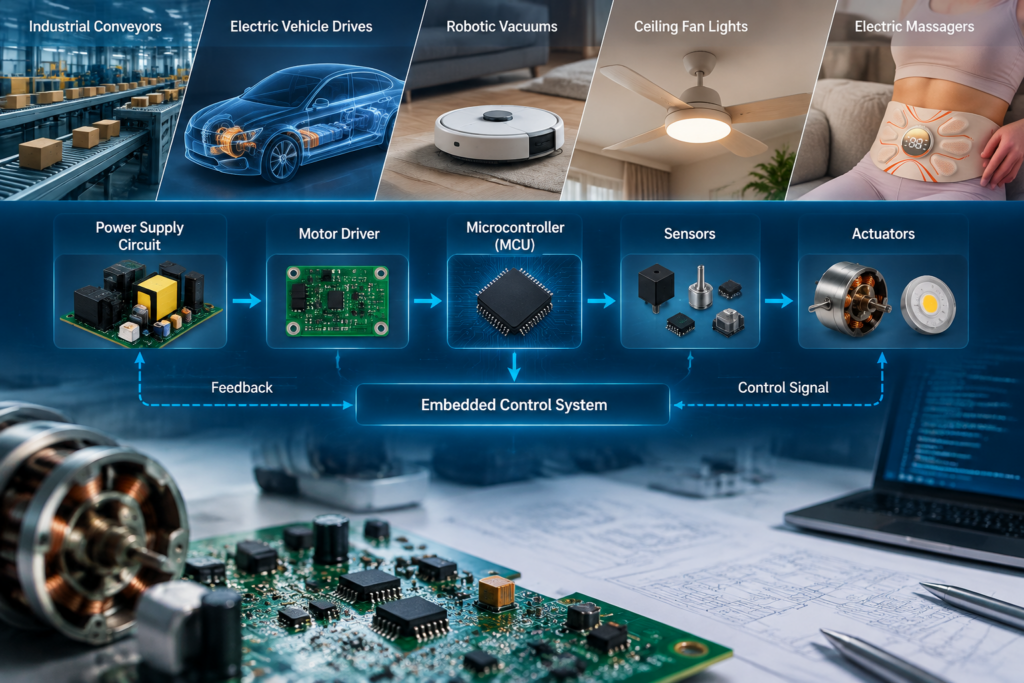
Electrical engineering and embedded systems work together in many modern electromechanical products, including industrial conveyors, electric vehicle drives, robotic vacuums, ceiling fan lights, and portable electric massagers.
These products can be broadly divided into two categories based on human interaction: non-contact devices that operate remotely and devices designed for direct contact with the body. Both categories represent important segments of the consumer BLDC market.
Using ceiling fan lights and massagers as examples, both rely on similar hardware architectures, including power circuits, motor drivers, and MCUs for electromechanical control. However, their user interactions and operating requirements differ. Comparing these products shows how embedded technologies adapt to different applications and how hardware design, control strategies, and safety features affect product performance and reliability.technologies.
1. Electrical Engineering and Embedded Systems in Modern Devices
1.1 Electrical Power, Circuits, and Hardware Design
Electrical engineering provides the foundation for power conversion, distribution, and control. Power from AC outlets or lithium-ion batteries must be converted through rectifiers, inverters, voltage regulators, or constant-current drivers to meet the needs of MCUs, motors, and LEDs.
Hardware design involves more than component selection. Circuit architecture, PCB layout, copper thickness, component ratings, insulation, and thermal management determine power capacity, heat dissipation, and resistance to interference.
In ceiling fan lights and electric massagers, poor circuit design can cause overheating, component failure, and safety risks. Control software must always operate within the hardware’s physical limits.
1.2 How Embedded Systems Connect Hardware and Software
Embedded systems combine electronic circuits with programmable control using MCUs, peripheral circuits, and firmware.
Sensors collect data such as current, temperature, motor position, and pressure. Analog-to-digital converters (ADCs) convert analog signals into digital data for MCU processing. The MCU then generates control signals, such as pulse-width modulation (PWM), to regulate power components.
This enables functions such as motor speed adjustment, lighting control, mode selection, and automatic shutdown in ceiling fan lights and electric massagers. Compared with dedicated control circuits, embedded systems offer greater flexibility and more advanced control capabilities.
1.3 Hardware–Software Integration in Smart Devices
ardware limitations, such as electrical noise, signal delays, and power response times, affect control accuracy. Meanwhile, software requirements for timing, feedback, and fault detection shape hardware design.
Together, hardware and firmware enable closed-loop control, monitoring operating conditions and adjusting outputs in real time.
For example, excessive motor current or temperature can trigger automatic power reduction or shutdown, while firmware manages timers, operating modes, and automatic switching.
Effective integration improves control accuracy, reliability, and system safety.
2. Core Technologies in Modern Electronics
2.1 Power Management and Distribution
Power management circuits supply MCUs, sensors, communication modules, and motor drivers. Key tasks include voltage regulation, ripple reduction, efficiency optimization, and standby power control.
Different components have different power requirements. Digital chips are sensitive to voltage drops and ripple, which can cause sampling errors or system crashes. Motor circuits must handle high startup currents and sudden load changes.
Poor power design can cause overheating, premature component aging, and intermittent failures that may not appear during initial testing.
2.2 Digital Logic and Microcontrollers
MCUs integrate timers, analog-to-digital converters (ADCs), communication interfaces, and interrupt controllers. They process sensor data, execute control logic, and manage multiple tasks.
Interrupts enable rapid responses to overheating, motor stalls, and overcurrent conditions. Timers generate pulse-width modulation (PWM) signals for motor speed control and LED dimming.
MCU selection requires balancing processing power, peripheral interfaces, Flash memory, and RAM. Insufficient resources can cause delays, while excessive capacity increases costs.
2.3 Power Electronics and Motor Control
MCU pins cannot directly drive high-power loads such as motors and LEDs. Power circuits use MOSFETs and gate drivers to control higher currents.
Brushless DC (BLDC) motors typically use three-phase inverter bridges, while LEDs use constant-current drivers.
Power-stage design focuses on reducing switching losses and electromagnetic interference (EMI), while ensuring components can handle startup surges and sudden load changes. Power components also generate heat, making thermal management essential.
2.4 Sensors and Feedback Control
Open-loop systems operate without feedback, while closed-loop systems use sensor data to adjust outputs dynamically.
Current-sensing resistors, NTC thermistors, Hall-effect sensors, and pressure sensors monitor operating conditions and send data to the MCU.
Firmware compares measured values with target settings and adjusts outputs using control methods such as proportional-integral-derivative (PID) control. Sensor accuracy, signal filtering, and response
Electrical engineering and embedded systems work together in many modern electromechanical products, including industrial conveyors, electric vehicle drives, robotic vacuums, ceiling fan lights, and portable electric massagers.
These products can be broadly divided into two categories based on human interaction: non-contact devices that operate remotely and devices designed for direct contact with the body. Both categories represent important segments of the consumer BLDC market.
Using ceiling fan lights and massagers as examples, both rely on similar hardware architectures, including power circuits, motor drivers, and MCUs for electromechanical control. However, their user interactions and operating requirements differ. Comparing these products shows how embedded technologies adapt to different applications and how hardware design, control strategies, and safety features affect product performance and reliability.technologies.
1. Electrical Engineering and Embedded Systems in Modern Devices
1.1 Electrical Power, Circuits, and Hardware Design
Electrical engineering provides the foundation for power conversion, distribution, and control. Power from AC outlets or lithium-ion batteries must be converted through rectifiers, inverters, voltage regulators, or constant-current drivers to meet the needs of MCUs, motors, and LEDs.
Hardware design involves more than component selection. Circuit architecture, PCB layout, copper thickness, component ratings, insulation, and thermal management determine power capacity, heat dissipation, and resistance to interference.
In ceiling fan lights and electric massagers, poor circuit design can cause overheating, component failure, and safety risks. Control software must always operate within the hardware’s physical limits.
1.2 How Embedded Systems Connect Hardware and Software
Embedded systems combine electronic circuits with programmable control using MCUs, peripheral circuits, and firmware.
Sensors collect data such as current, temperature, motor position, and pressure. Analog-to-digital converters (ADCs) convert analog signals into digital data for MCU processing. The MCU then generates control signals, such as pulse-width modulation (PWM), to regulate power components.
This enables functions such as motor speed adjustment, lighting control, mode selection, and automatic shutdown in ceiling fan lights and electric massagers. Compared with dedicated control circuits, embedded systems offer greater flexibility and more advanced control capabilities.
1.3 Hardware–Software Integration in Smart Devices
ardware limitations, such as electrical noise, signal delays, and power response times, affect control accuracy. Meanwhile, software requirements for timing, feedback, and fault detection shape hardware design.
Together, hardware and firmware enable closed-loop control, monitoring operating conditions and adjusting outputs in real time.
For example, excessive motor current or temperature can trigger automatic power reduction or shutdown, while firmware manages timers, operating modes, and automatic switching.
Effective integration improves control accuracy, reliability, and system safety.
2. Core Technologies in Modern Electronics
2.1 Power Management and Distribution
Power management circuits supply MCUs, sensors, communication modules, and motor drivers. Key tasks include voltage regulation, ripple reduction, efficiency optimization, and standby power control.
Different components have different power requirements. Digital chips are sensitive to voltage drops and ripple, which can cause sampling errors or system crashes. Motor circuits must handle high startup currents and sudden load changes.
Poor power design can cause overheating, premature component aging, and intermittent failures that may not appear during initial testing.
2.2 Digital Logic and Microcontrollers
MCUs integrate timers, analog-to-digital converters (ADCs), communication interfaces, and interrupt controllers. They process sensor data, execute control logic, and manage multiple tasks.
Interrupts enable rapid responses to overheating, motor stalls, and overcurrent conditions. Timers generate pulse-width modulation (PWM) signals for motor speed control and LED dimming.
MCU selection requires balancing processing power, peripheral interfaces, Flash memory, and RAM. Insufficient resources can cause delays, while excessive capacity increases costs.
2.3 Power Electronics and Motor Control
MCU pins cannot directly drive high-power loads such as motors and LEDs. Power circuits use MOSFETs and gate drivers to control higher currents.
Brushless DC (BLDC) motors typically use three-phase inverter bridges, while LEDs use constant-current drivers.
Power-stage design focuses on reducing switching losses and electromagnetic interference (EMI), while ensuring components can handle startup surges and sudden load changes. Power components also generate heat, making thermal management essential.
2.4 Sensors and Feedback Control
Open-loop systems operate without feedback, while closed-loop systems use sensor data to adjust outputs dynamically.
Current-sensing resistors, NTC thermistors, Hall-effect sensors, and pressure sensors monitor operating conditions and send data to the MCU.
Firmware compares measured values with target settings and adjusts outputs using control methods such as proportional-integral-derivative (PID) control. Sensor accuracy, signal filtering, and response.
3. Ceiling Fan Lights: Motor Control, Lighting, and Embedded Systems
3.1 BLDC Motors and Airflow Control
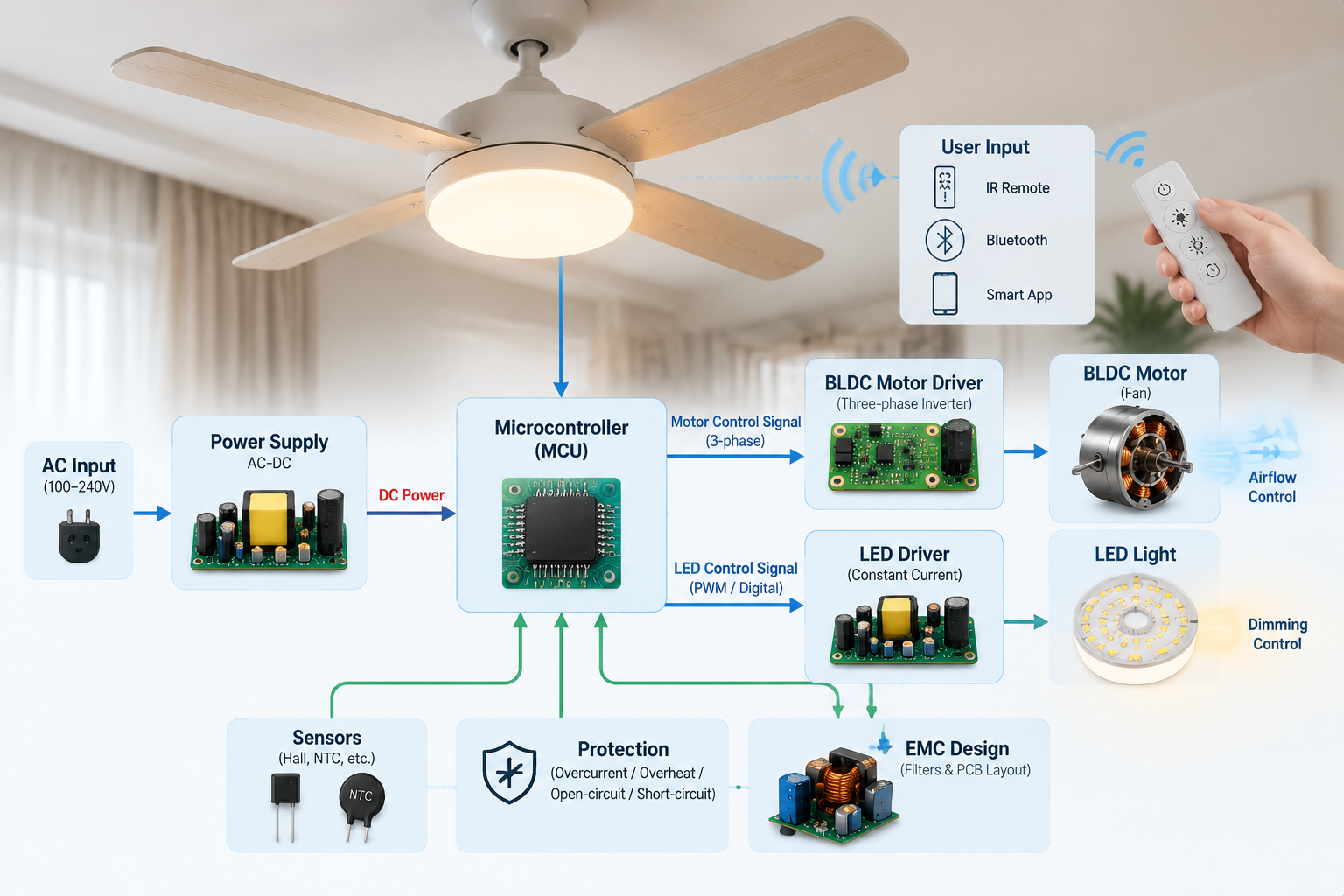
Ceiling fan lights commonly use BLDC motors, which use electronic commutation to reduce friction, wear, and noise. Hall sensors detect rotor position, allowing the controller to regulate motor speed through a three-phase inverter.
Sensorless field-oriented control (FOC) can be challenging at low speeds, where weak current signals may cause position estimation errors and motor vibration. Engineers tune signal filtering, FOC observers, and PI parameters to ensure stable operation in low-speed modes, such as sleep mode. This was also a key challenge during Nebola’s development.
3.2 LED Drivers and Dimming Control
LEDs require regulated current because small voltage changes can cause large current variations and damage the LEDs.
Switching LED drivers regulate current and may provide electrical isolation. PWM or digital signals control brightness, while built-in protection can respond to overcurrent, open-circuit, and short-circuit faults.
3.3 Embedded Control and Operating Modes
The main MCU processes infrared or Bluetooth commands and coordinates fan and lighting functions. Firmware manages motor speed, brightness, timers, and smart-home features.
In sleep mode, the MCU can gradually reduce fan speed and brightness. Efficient task scheduling helps prevent control delays when processing power and memory are limited.
3.4 System Reliability, EMC, and Electrical Safety
Motor switching noise can interfere with wireless communication. LC filters and careful PCB grounding and layout help reduce electromagnetic interference (EMI).
NTC thermistors monitor component temperatures, allowing the controller to reduce power or shut down the system if temperatures exceed safe limits. Insulation, creepage distances, and electrical clearances must meet applicable safety standards for mains-powered devices.
3. Electric Massagers: Motion Control and User-Centered Design
4.1 Motor Drives and Mechanical Motion
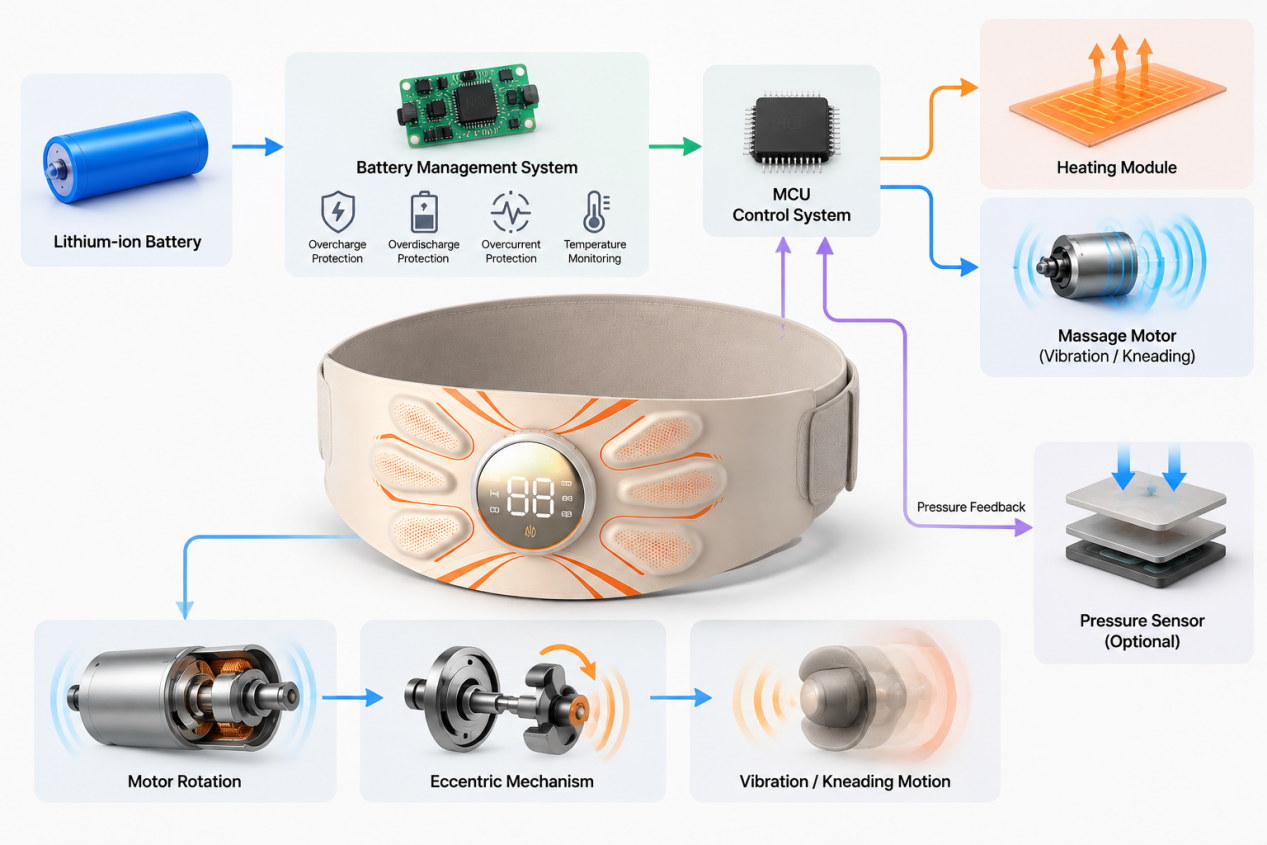
Electric massagers, including massage belts, use motors and mechanical transmission systems to produce vibration, kneading, or percussive motion. Eccentric mechanisms and linkages convert motor rotation into the desired movement.
These mechanisms can create sudden changes in mechanical load, causing current spikes and increased motor torque. The drive circuit must handle these peaks, with appropriately rated components to reduce electrical stress and prevent premature failure.
4.2 Embedded Control: Speed, Timing, and Pressure Feedback
Embedded systems manage operating modes, speed settings, timers, and protective functions. In devices equipped with pressure sensors, the MCU can use measured pressure to adjust motor output and reduce intensity when excessive pressure is detected.
For example, products such as Starbright’s electronic massage devices illustrate how programmable control can support adjustable operation and user interaction. Actual pressure-feedback functions depend on the specific product design.
4.3 Battery Management and Runtime Optimization
Portable massage belts and massagers often use rechargeable lithium-ion batteries. A battery management system (BMS), where implemented, helps protect against overcharging, overdischarging, overcurrent, and short circuits. Temperature monitoring can also help manage charging and discharging under high-temperature conditions.
Battery capacity, motor power, and control settings affect runtime. Engineers must balance operating time, battery size, device weight, and thermal performance.
5.Engineering Design Insights from Two Product Categories
5.1 Shared Core Technologies
| Parameter | Ceiling Fan Lights (NEBOLA) | Electric Massagers (Starbright) |
| Load Characteristics | Long-duration, continuous operation | Intermittent operation with dynamic load variations |
| Control Objectives | Stable speed, low electromagnetic noise, and consistent energy efficiency | Dynamic torque adjustment and user comfort optimization |
| Power Supply | AC 220V mains power | Portable lithium-ion battery power |
| Key Design Considerations | Long-term reliability, EMC, and energy efficiency | Temperature control and overload protection |
| Human Interaction | Non-contact device designed for remote operation | Direct-contact device that operates against the user’s body |
| Control Interface | Remote control and smart home integration | Direct physical contact and real-time pressure feedback |
Although both product categories share similar hardware building blocks—including power management, MCU control, power drivers, and sensor feedback—their human interaction requirements are fundamentally different.
Ceiling fan lights are non-contact devices operated at a distance, while electric massagers are direct-contact devices used against the human body. Combined with differences in load characteristics and power supply, these factors lead to different priorities in control algorithms, protection mechanisms, thermal management, and EMC design.
This highlights a key principle in electromechanical engineering: a shared technology platform requires application-specific design to meet different operating conditions.
5.1 Shared Hardware, Different Design Requirements
| Parameter | Ceiling Fan Lights (NEBOLA) | Electric Massagers (Starbright) |
| Load Characteristics | Long-duration, continuous operation | Intermittent operation with dynamic load variations |
| Control Objectives | Stable speed, low electromagnetic noise, and consistent energy efficiency | Dynamic torque adjustment and user comfort optimization |
| Power Supply | AC 220V mains power | Portable lithium-ion battery power |
| Key Design Considerations | Long-term reliability, EMC, and energy efficiency | Temperature control and overload protection |
| Human Interaction | Non-contact device designed for remote operation | Direct-contact device that operates against the user’s body |
| Control Interface | Remote control and smart home integration | Direct physical contact and real-time pressure feedback |
Although both product categories share core hardware components, including power management, MCU control, power drivers, and sensor feedback, their human interaction requirements differ.
Ceiling fan lights are non-contact devices, while electric massagers operate in direct contact with the body. Differences in load characteristics and power supply also shape their control algorithms, protection mechanisms, thermal management, and EMC requirements.
This highlights a key engineering principle: shared technology requires application-specific design.
5.2 Performance, Energy Efficiency, and Cost
Engineering design involves trade-offs between performance, energy efficiency, and cost. A higher-spec BLDC drive system can improve efficiency and reduce noise, but it also increases component and PCB costs. A larger lithium-ion battery extends operating time but adds weight, size, and material costs.
During product development, these three factors must be prioritized based on the product’s positioning. Rather than optimizing one metric in isolation, engineers need to evaluate the entire system. Firmware can compensate for some limitations, but it cannot eliminate the physical constraints of the hardware.
5.3 Safety and Reliability
Performance issues can often be improved through design iterations, but safety failures can lead to product recalls and serious accidents.
The safety priorities differ between the two product categories. Non-contact devices primarily require electrical insulation, EMC compliance, and reliable long-term operation. Devices that come into direct contact with the body also need additional protection against torque overload and excessive surface temperatures to prevent mechanical or thermal injuries.
EMC, electrical insulation, thermal protection, and fault detection must be considered from the initial design stage, not added as afterthoughts during late-stage prototyping.
Reliability engineering should cover component derating, thermal margins, and fault protection throughout the entire development process, from schematic design and PCB fabrication to prototype validation and aging tests.
5.4 Hardware-Software Integration Testing to Prevent System-Level Risks
Many system failures are caused not by hardware or software alone, but by problems in how the two interact.
Power fluctuations can affect sensor readings, control commands may conflict with power-switching timing, and circuit noise can interfere with signal acquisition. These issues often become apparent only during hardware-software integration testing.
Testing both sides together during the prototype stage helps identify system-level risks early and reduces the likelihood of costly rework after mass production.
6. Future Trends in Embedded Systems and Electrical Engineering
6.1 Lightweight Embedded Systems and Adaptive Control
Although MCU processing capabilities continue to improve, embedded software is moving toward lightweight designs. Removing unnecessary logging and redundant code while retaining essential routines for motor control, fault protection, and signal acquisition can reduce firmware size and MCU power consumption.
Future products may integrate additional environmental and user-related sensors alongside existing current and temperature sensors. Control algorithms can then adjust operating parameters based on real-time feedback. For example, ceiling fan lights can adjust fan speed and lighting output based on ambient temperature, while massage devices can regulate motor torque and massage frequency based on contact pressure and housing temperature, moving beyond fixed operating modes toward adaptive control.
6.2 Device Connectivity and Unified IoT Ecosystems
The Matter smart home standard provides a common communication framework across different device categories, allowing ceiling fan lights and massage devices to connect to the same home gateway and interact with one another.
For example, when a motion sensor detects a person, it can trigger a massage device while adjusting fan speed and lighting. Standardized protocols enable cross-device automation, reducing reliance on separate apps and creating a more integrated home electromechanical control system.