Executive Summary
The rapid integration of gamified learning platforms such as Kahoot!, Quizizz, and Blooket has transformed modern pedagogy by significantly enhancing student engagement, motivation, and academic performance across various educational levels [1], [2], [4]. Meta-analyses indicate that these tools yield moderate-to-large positive effects on learning outcomes, with Kahoot showing substantial impacts on retention (1.492) and academic achievement (0.772) [2], [9]. However, this “gamification revolution” has simultaneously birthed a sophisticated “cheating economy” characterised by automated answer bots, flooder scripts, and, more recently, the integration of Generative Artificial Intelligence (GenAI) like ChatGPT to circumvent assessment integrity [23], [28], [45].
This report examines the dual nature of these platforms: their documented pedagogical effectiveness versus the rising threats to academic integrity. While platforms like Quizizz have introduced basic mitigation strategies—such as randomised question shuffling and immediate feedback—to reduce peer-to-peer cheating [13], [15], scholarly evidence reveals a significant research gap regarding platform-specific bot prevention and the long-term ethical implications of automated proctoring [19], [33]. The findings suggest that as gamified assessments transition from low-stakes review tools to formal evaluation metrics, educators must adopt a multi-layered security approach. This includes technological interventions like AI-driven behaviour detection and blockchain authentication, alongside pedagogical shifts toward isomorphic question design and personalised assessment tasks [27], [39], [44]. Ultimately, the report highlights the necessity for a balanced “AI-meets-AI” strategy to preserve the motivational benefits of gamification while safeguarding the validity of educational data [24], [26].
Table of Contents
1. Introduction: The Gamification of Education and the Rise of the Bot
2. The Pedagogical Foundation: Effectiveness and Comparative Benefits
3. The Emerging Threat Landscape: Bots, Flooders, and Generative AI
4. Mitigation and Security Strategies: Technological and Pedagogical Responses
5. Limitations and Research Gaps: The Integrity Blind Spot
6. Conclusion and Future Directions
1. Introduction: The Gamification of Education and the Rise of the Bot
The landscape of 21st-century education has been irrevocably altered by the “gamification” of the classroom. Platforms such as Kahoot!, Quizizz, and Blooket have moved from the periphery of educational technology to the core of daily instruction, serving as vital tools for formative assessment, content review, and student engagement [1], [3], [10]. These platforms leverage game-based psychology—specifically elements of competition, scoring, and instant feedback—to foster “meaningful teaching and learning” [1], [20].
However, the very features that make these platforms engaging—their competitive nature and leaderboard-driven rankings—have also made them targets for exploitation. In the “hidden curriculum” of student digital life, a robust ecosystem of “school cheats” has emerged. Tools such as “Kahoot Bot Flooders” and “Blooket Auto-Answers” have become commonplace, allowing students to automate their performance and disrupt the learning environment. This phenomenon represents more than a simple nuisance; it constitutes a direct challenge to the validity of formative assessment data and the fairness of the digital classroom [35], [41].
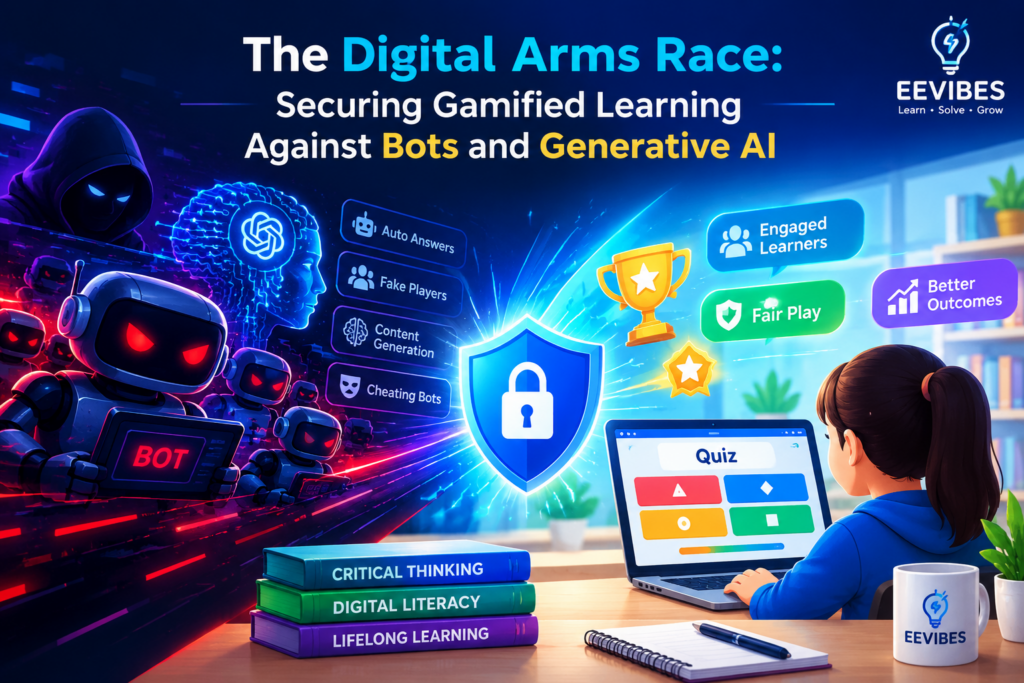
As educational institutions increasingly rely on these digital platforms, particularly in the wake of the shift toward remote and blended learning, the “digital arms race” between platform security and cheating technologies has intensified [31], [42]. This report seeks to bridge the gap between the celebratory literature on gamification’s effectiveness and the technical literature on academic integrity, providing a comprehensive analysis of how to secure gamified learning in the age of bots and generative AI.
2. The Pedagogical Foundation: Effectiveness and Comparative Benefits
2.1 Documented Impacts on Learning Outcomes
The scholarly consensus on gamified learning platforms is overwhelmingly positive regarding their impact on student affective and cognitive domains. Systematic reviews and meta-analyses consistently report that Kahoot! and Quizizz increase active participation, knowledge retention, and overall academic achievement [2], [3], [4], [9]. For instance, a comprehensive meta-analysis found that Kahoot! significantly influences motivation (0.960) and attitudes (0.678), while notably reducing student anxiety (-0.338) [2].
In higher education settings, Kahoot! has been shown to contribute nearly 49.4% to the variance in active participation and learning outcomes [4]. Similar findings are observed in primary education, where the use of these tools has been linked to an increase in learning outcomes from 64 to 81 [3]. The “Octalysis Audit” of Kahoot! reveals an excellent balance between positive and negative motivation, as well as intrinsic and extrinsic drivers, which explains its high adoption rate and student enthusiasm [20].
2.2 Comparative Analysis: Kahoot! vs. Quizizz
While both platforms are effective, they offer distinct pedagogical advantages. Meta-analytic evidence suggests that Quizizz may have a slightly better application effect than Kahoot! in certain contexts, particularly in procedural knowledge learning and humanities subjects [9]. From a student perspective, both platforms are perceived as “addictive” and motivating, fostering a competitive yet collaborative environment [13], [16].
A critical differentiator lies in the assessment design. Quizizz is often preferred for more formal evaluations, such as mid-semester and final assessments, due to its student-paced nature and built-in cheating mitigation features [10], [15]. In contrast, Kahoot! is frequently cited as the more popular tool for “live” classroom dynamics and immediate, high-energy engagement [12], [16]. However, some researchers caution that the high enjoyment levels associated with these platforms can sometimes divert student attention from “deeper learning objectives,” emphasizing the need for effective pedagogical design over mere entertainment [5].
2.3 Subject-Specific Applications and Effectiveness
The effectiveness of gamification is not uniform across all disciplines. In **Chemistry**, Kahoot! has been shown to enhance study motivation and attentiveness among undergraduates [7]. In **Mathematics**, it strengthens basic concepts, though students may sometimes focus more on competition than comprehension [8], [21]. **Language Learning (EFL)** also sees significant gains, with tools like Quizizz improving vocabulary and engagement, though teachers face challenges like technical errors and time management [11], [14], [18], [22].
3. The Emerging Threat Landscape: Bots, Flooders, and Generative AI
3.1 The Bot Economy and Data Integrity
The rise of automated “bots” represents a significant threat to the integrity of online assessments. “Kahoot Bot Flooders” function by injecting hundreds of “fake” participants into a live game, often crashing the session or overwhelming the teacher’s dashboard. More insidious are the “Auto-Answer” bots, which scrape the platform’s API to identify the correct answer in real-time, allowing students to achieve perfect scores without engaging with the content.
Research indicates that the presence of bots in online environments not only compromises assessment data but also threatens the integrity of educational research conducted through these platforms [35], [41]. When data collections are “flooded” by bots, the resulting quantitative analysis becomes unreliable.
3.2 Generative AI and the “Cheating Dilemma”
The emergence of Generative Artificial Intelligence (GenAI), such as ChatGPT, has introduced a new layer of complexity [28], [45]. Students can use GenAI to solve complex quiz questions in seconds, bypassing the need for critical thinking. This “cheating dilemma” has forced higher education institutions to reconsider their assessment policies and proctoring strategies [29], [46]. Surveys suggest that students frequently utilize these tools for university-related tasks, often without a clear understanding of the ethical boundaries [37], [40].
4. Mitigation and Security Strategies: Technological and Pedagogical Responses
4.1 Built-in Mitigation: Randomization and Shuffling
One of the most effective solutions for mitigating peer-to-peer cheating is question and answer randomization. Platforms like Quizizz utilize this feature to ensure that each student receives a unique sequence, preventing them from copying neighbors [13], [15]. This design encourages students to focus on their own work and reduces casual cheating.
4.2 Advanced Technological Interventions
For higher-stakes assessments, more robust technological solutions are required:
– AI-Driven Detection: Systems using behavioral classification and IP analysis to detect suspicious activities [25], [32], [38].
– Secured Authentication: Integrating blockchain technology and cryptography to ensure the integrity of user identities [27], [47].
– Autonomous Proctoring: The use of software that monitors students in real-time, which remains controversial due to privacy concerns [33], [34], [43].
– Safe Exam Browsers:Utilizing open-source software to lock down devices, preventing the use of external bots or AI tools [49].
4.3 Pedagogical Shifts: Isomorphic and Personalized Assessments
Beyond technological “fixes,” researchers advocate for a shift in how assessments are designed. The creation of “isomorphic questions”—where the underlying concept is the same but specific variables differ—can significantly reduce the utility of answer-sharing [39]. Furthermore, systems for “personalized assessments” tailored to individual student profiles can make each exam unique and mitigate cheating [44], [48].
5. Limitations and Research Gaps: The Integrity Blind Spot
Despite the proliferation of gamified tools, a significant “integrity blind spot” exists. Many studies focus on “platform features” or “engagement metrics” while ignoring actual learning outcomes and the impact of bot abuse [17], [19]. Specifically, there is a lack of platform-specific research on how to prevent bot usage in Kahoot! and Blooket without compromising the “fun” and “fairness” that make these tools effective [19].
Furthermore, the ethics of advanced proctoring remain a point of contention. While surveillance ensures integrity, it can create a stressful environment that negatively affects student motivation [33], [43]. There is a pressing need for research examining the “long-term effects” of gamification on academic integrity [6].
6. Conclusion and Future Directions
The integration of gamified learning platforms has undoubtedly enriched the educational experience, providing powerful tools for engagement and assessment. However, the rise of bots and Generative AI has necessitated a more proactive and security-conscious approach. The “digital arms race” is not merely a technical challenge but a pedagogical one, requiring educators to balance the pursuit of engagement with the preservation of academic integrity [42]. Future research must address the “security requirements” of the digital classroom [36] and develop “trustworthy remote assessments” that combine technological safeguards with ethical pedagogical practices [30].